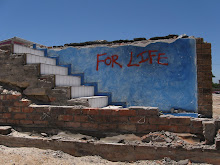
If you had found me asleep on the floor of a practice room in the basement of the South African College of Music today, you might have felt pity for me. Indeed, I was exhausted. I had spent the night in a vigil. I had kept watch until I was certain that things were safe, until I could see Table Mountain in the sun’s light, and until another light had also risen in the corner of the sky. But once I saw that light, I was in no need of pity.
The election was called at 6:00 am here. I was at Café Sofia’s on Main Road, with some fifty or sixty others – mostly, but not entirely, Americans. The screams were deafening, and their intensity was matched by the squeeze of hugs from strangers. Tears of joy were shed. Some were even hysterical.
Joy (the person) and I stepped out into the morning light and started for home. We found it difficult to contain ourselves, and announced the news to strangers on the street. I only had a couple of hours to sleep before I had to accompany a fellow student for a practical exam. On the way to the college I passed Christopher, the security guard. He asked me if things would really be different from now on.
For many of us, Africans and Americans alike, this election has played to our archetypal notion of the hero, who slays the dragon and earns dominion over the kingdom. This, combined with a vision of an America that is no longer a global parasite, inspires a new sense of patriotism in many Americans to whom that word has had negative connotations for at least eight years.
We elected our new leader because he promised change, but as he reminded us in his speech, we can’t just vote change into office. We must be the change. This spirit, this energy, this hysteria – let it not be an ephemeral flame, only to be put out when we are reminded of the cold complications of reality. Though we may now see the stars and stripes in a warmer light, patriotism will be no easier in practice.
The time could not be riper for us to examine what the practice of patriotism means. For me, especially since I have been here, patriotism means seeing my country in a global context. One of the most stark realities that we face when we look at this picture is that , in our use of resources and production of waste, we are enforcing the inequality which we ideologically condemn. Our citizens simply have more available to them, and have developed a culture where the unsustainable use of resources is a norm. Unsustainable means that the remaining global resources are suffering because of it, but our citizens also largely have the power to isolate themselves from the consequences. So the burden is left on the shoulders of the economically weaker nations. For these nations, this is what the American flag symbolizes.
Culture is not an easy thing to change. Change comes with the inspiration of an event of mythological significance, and charismatic leaders to sustain that inspiration. In other words, the logs are stacked and the kindling is lit. It is up to us to fan the flame.
Wednesday, November 5, 2008

Tuesday, October 21, 2008
Ch.8: Spectator Democracy
Today I went to the post office to mail my absentee ballot. I had almost forgotten that voting was work. I spent the whole morning researching the candidates for the state and municipal offices. These are positions that I know are important, like the state supreme court justices who serve for 12 years, and the mayor of my hometown. But I felt completely out of the loop when it came to choosing. I would say it’s because I’m overseas, but I remember the same feeling on the day of the primaries back home.
Nevertheless, I felt obligated to go through with it, to walk my envelope fifteen minutes down Main Road to the post office, and to pay R27.90 for an international stamp. After all, I was the one who put up posters all over campus appealing to Americans to get their absentee ballots.
I did not exactly make these signs out of a pure longing to increase participation in democracy. Demographics motivated me: American students abroad, in Africa, many of them studying international development… I could picture how most of their ballots would turn out, at least in the presidential election. But I do generally think it’s a good idea to vote, at least if you follow current events, which is also a good idea. My housemate, who doesn’t like to discuss politics so I’ll keep him nameless, has decided that he will not vote. I argued with him a bit, for the sake of understanding his perspective. He said there’s no way to really know the candidates before they’re in office, plus he’s tired of people saying that people died so that he could vote.
The signs were quite successful – most of the confetti strips are gone by now. I didn’t really expect such success, and I expected a little more commentary. I found a “LOSERS” scrawled on one, but other than that they were spared the anti-American sentiment which is a common theme in South Africans’ conversations. “JEALOUS,” I could write back. South Africa does not hold public presidential elections. During general elections, citizens vote for their party of choice, and the percentage of the vote won by each party determines the makeup of the National Assembly. The National Assembly then votes for the President, which is usually the leader of the party which is in the majority. But there’s a catch – there’s really only one party, the African National Congress (ANC), which led the revolution that culminated in Nelson Mandela’s rise to power in 1994. In the last election, the ANC received almost 70% of the vote, with the next party in line, the Democratic Alliance, coming in at 12%. We complain about a two-party system, but here they’ve got it worse.
In the last few weeks, however, a new solution has been presenting itself. Last month, President Thabo Mbeki was asked to step down, and he obliged. The head of the ANC, Jacob Zuma, had been tapping his fingers on his desk in anticipation of the end of Mbeki’s term midway through next year. But a corruption case threatened his eligibility as a candidate. This was dismissed by a controversial ruling, but not resolved in everyone’s mind. The ANC decided that Mbeki was too closely involved in the fight to disqualify Zuma, and pulled him from the presidential office. To appease the disquieted masses they didn’t put Zuma in directly, but chose an interim President, Kgalema Motlanthe, to finish out the term. Cabinet members and ministers resigned in solidarity with Mbeki and, under the direction of Mosiuoa “Terror” Lekota, disillusioned ANC members are now forming a break-away party to contest Zuma in the upcoming elections.
It didn’t help my argument with my housemate that former Anglican archbishop Desmond Tutu, a Nobel laureate and influential figure all over the world, has said that he will not vote unless the ANC heals its divisions. This argument confounds me as much as my housemate’s – is he not saying, “I refuse to vote unless I don’t have a choice”?
Amidst all of this drama, South Africans are also following another soap opera, the U.S. elections. But they know the drama is also not confined to the TV screen. At church on Sunday the minister prayed for America’s elections which, he said, will be momentous in determining the future of both the U.S. and South Africa. South Africans aren’t too divided about the candidate they support. And it’s not just because his father’s from Kenya, but that probably doesn’t hurt. The silk-screen-style stickers with his face, eyes turned upward, are a common road-sign and waste bin adornment, just as they are in the U.S.
It might actually be more democratic if South Africans did vote in the U.S. elections, along with Iraqis, Costa Ricans, and all others who float on the tides of U.S. foreign policy. And it extends beyond foreign policy, as seen in the global impact of the American financial crisis. The value of the South African rand is falling alongside the U.S. dollar but at a much higher rate, defying Galilean physics. In fact, the ZAR:USD rate is at a record high in recent history.
But, despite having strong opinions and vested interest, South Africans must stay on the sidelines in both the American elections and their own. They must leave the U.S. election to the Americans, who they see as ignorant and self-absorbed. I am hoping that the results of this election will help to heal this image.
Nevertheless, I felt obligated to go through with it, to walk my envelope fifteen minutes down Main Road to the post office, and to pay R27.90 for an international stamp. After all, I was the one who put up posters all over campus appealing to Americans to get their absentee ballots.
I did not exactly make these signs out of a pure longing to increase participation in democracy. Demographics motivated me: American students abroad, in Africa, many of them studying international development… I could picture how most of their ballots would turn out, at least in the presidential election. But I do generally think it’s a good idea to vote, at least if you follow current events, which is also a good idea. My housemate, who doesn’t like to discuss politics so I’ll keep him nameless, has decided that he will not vote. I argued with him a bit, for the sake of understanding his perspective. He said there’s no way to really know the candidates before they’re in office, plus he’s tired of people saying that people died so that he could vote.
The signs were quite successful – most of the confetti strips are gone by now. I didn’t really expect such success, and I expected a little more commentary. I found a “LOSERS” scrawled on one, but other than that they were spared the anti-American sentiment which is a common theme in South Africans’ conversations. “JEALOUS,” I could write back. South Africa does not hold public presidential elections. During general elections, citizens vote for their party of choice, and the percentage of the vote won by each party determines the makeup of the National Assembly. The National Assembly then votes for the President, which is usually the leader of the party which is in the majority. But there’s a catch – there’s really only one party, the African National Congress (ANC), which led the revolution that culminated in Nelson Mandela’s rise to power in 1994. In the last election, the ANC received almost 70% of the vote, with the next party in line, the Democratic Alliance, coming in at 12%. We complain about a two-party system, but here they’ve got it worse.
In the last few weeks, however, a new solution has been presenting itself. Last month, President Thabo Mbeki was asked to step down, and he obliged. The head of the ANC, Jacob Zuma, had been tapping his fingers on his desk in anticipation of the end of Mbeki’s term midway through next year. But a corruption case threatened his eligibility as a candidate. This was dismissed by a controversial ruling, but not resolved in everyone’s mind. The ANC decided that Mbeki was too closely involved in the fight to disqualify Zuma, and pulled him from the presidential office. To appease the disquieted masses they didn’t put Zuma in directly, but chose an interim President, Kgalema Motlanthe, to finish out the term. Cabinet members and ministers resigned in solidarity with Mbeki and, under the direction of Mosiuoa “Terror” Lekota, disillusioned ANC members are now forming a break-away party to contest Zuma in the upcoming elections.
It didn’t help my argument with my housemate that former Anglican archbishop Desmond Tutu, a Nobel laureate and influential figure all over the world, has said that he will not vote unless the ANC heals its divisions. This argument confounds me as much as my housemate’s – is he not saying, “I refuse to vote unless I don’t have a choice”?
Amidst all of this drama, South Africans are also following another soap opera, the U.S. elections. But they know the drama is also not confined to the TV screen. At church on Sunday the minister prayed for America’s elections which, he said, will be momentous in determining the future of both the U.S. and South Africa. South Africans aren’t too divided about the candidate they support. And it’s not just because his father’s from Kenya, but that probably doesn’t hurt. The silk-screen-style stickers with his face, eyes turned upward, are a common road-sign and waste bin adornment, just as they are in the U.S.
It might actually be more democratic if South Africans did vote in the U.S. elections, along with Iraqis, Costa Ricans, and all others who float on the tides of U.S. foreign policy. And it extends beyond foreign policy, as seen in the global impact of the American financial crisis. The value of the South African rand is falling alongside the U.S. dollar but at a much higher rate, defying Galilean physics. In fact, the ZAR:USD rate is at a record high in recent history.
But, despite having strong opinions and vested interest, South Africans must stay on the sidelines in both the American elections and their own. They must leave the U.S. election to the Americans, who they see as ignorant and self-absorbed. I am hoping that the results of this election will help to heal this image.
Wednesday, September 24, 2008
Ch. 7: In the Sky
Mikail and I had our hands full. Paints, brushes, paper, and most bulkily, bags of potatoes. It was the last day before spring break, and the coordinator for our volunteer group was already on her way to Johannesburg, so she had asked us to fetch the materials from the SHAWCO office. SHAWCO is a student volunteer organization at UCT which buses university students into the townships to run various programs from tutoring to the arts for students of all grades. My program is an arts workshop, and we go into Manenburg, a coloured township, every Friday for three hours. Today we were going to be turning potatoes into stamps, dipping them in paint, and making pictures. A plan obviously devised by someone not wearing light-colored clothes.
Most of our group is American exchange students. Anxious to take advantage of the break from classes, many planned trips to Botswana, Namibia, Lesotho, or other places in South Africa. When Mikail and I got back to the SHAWCO van, we found that most of our group had left early for these trips, and we were down from about twelve to about five. Mikail and I were both leaving the next day: he to Swaziland to conduct AIDS research, and I to Kruger national park to see animals. Of the other students, one was a South African and therefore less anxious to see the continent, and one, Terrance, had made certain that his travel plans did not conflict with our SHAWCO activities. In the van we discussed our strategies for keeping the butter knives out of small hands while still giving students creative control over the shape of their potatoes. It was going to be tough to control around fifty energetic 3rd through 7th graders with so few of us.
As usual, the kids had no trouble entertaining themselves, but it was our place to guide them through activities that “develop character, confidence, and self-expression,” as the SHAWCO material words it. One unique problem today was that the kids wanted to eat the potatoes – raw – more than paint with them. At the end of the activities we had a pile of works which were the pride of their creators, but would be forgotten about after playing outside for thirty minutes. When it came time to leave, we faced a gauntlet of hugs and piggy back rides. Terrance’s path contained the most such obstacles, and we waited in the van as he made his way through them, telling children that he not see them next week, but the week after.
He finally climbed in the van and we pulled out of the school. “They’re so CUTE!” he shouted as we waved goodbye. A black southerner, Terrance’s accent was unique among the American students, and even more so in South Africa. But this didn’t deter him from using his voice – to praise, to comment, to laugh -- always with enthusiasm. In the van he warned us that he was going to say something scandalous, and then bemoaned the low turnout in light of the view of Americans as interested in service only on a superficial level. This engaged us all in a discussion of the matter, which lasted until we let Terrance off on Main Road. “He’s a character and a half,” someone observed with a chuckle.
The next day I was to leave with three of my housemates – Anne, Aadesh, and Daksha – for our Kruger park safari. Kruger, in the northeast corner of the country, is the most famous of the national parks in South Africa, and is known as a haven for the kinds of animals that are always poking their heads out of Noah’s Ark on the walls of babies’ rooms – elephants, zebras, lions, giraffes, hippos, rhinos, crocodiles, buffalo, and many more. I got onboard late in the planning stages – I was mostly interested in an adventure with my friends, and glad for the chance to see the countryside. On the day we left the wind blew like I had never seen it here. The cab picked me up from a café on Main Road, where I had been drinking hot chocolate and watching the few people on the streets fighting to walk. On the way to the airport the rain started, and soon we could barely see out of the car windows.
The weather was pleasant in Johannesburg, and by the time we arrived at Kruger it was 100 degrees. In Cape Town, however, the weather worsened. The rain continued through the week and flooding began in earnest. The sea, too, was losing its calm.
So while Cape Town was flooding, we were with Noah’s animals. A Shangaan man who had been a tracker for 6 ½ years drove us around in a safari truck, and taught us about the animals’ behavior. We camped in luxury campsites, and our meals were prepared by chefs. One night I received a text message from Garth of the Khoi Khonnexion: an American student at UCT had been swept out to sea – was I okay?
The following Friday we were back in Manenburg. We had a better turnout of volunteers today, but our task was much more difficult. We were somber as we stood in a circle and held hands, and I taught the children “May the Circle Be Unbroken,” which they picked up quickly:
May the circle be unbroken,
By and by, Lord, by and by
There’s a better home a-waitin’
In the sky, Lord, in the sky
Poetry, one of the volunteers, went to the front of the room. “Can you point to the sky?” she asked. They did. “Do you remember Terrance?” They did. She quivered a little, “Terrance passed away last week, and now he’s in the sky.” She was one of his best friends, and had been with him when a freak wave came and swept him off of a rock. We passed out paper and pencils, and the children made cards for his mother. Many of the cards were addressed to Terrance himself: “We miss you Terrance,” and “I love you.” The children were shocked, but I believe their art was therapeutic – remembering him through pictures and words. And Terrance’s mother, over the ocean and in a hospital bed, will no doubt be comforted when she sees the impact her son made on these children. As for us, it has been hard not to notice the silence where his Alabama voice used to be.
Most of our group is American exchange students. Anxious to take advantage of the break from classes, many planned trips to Botswana, Namibia, Lesotho, or other places in South Africa. When Mikail and I got back to the SHAWCO van, we found that most of our group had left early for these trips, and we were down from about twelve to about five. Mikail and I were both leaving the next day: he to Swaziland to conduct AIDS research, and I to Kruger national park to see animals. Of the other students, one was a South African and therefore less anxious to see the continent, and one, Terrance, had made certain that his travel plans did not conflict with our SHAWCO activities. In the van we discussed our strategies for keeping the butter knives out of small hands while still giving students creative control over the shape of their potatoes. It was going to be tough to control around fifty energetic 3rd through 7th graders with so few of us.
As usual, the kids had no trouble entertaining themselves, but it was our place to guide them through activities that “develop character, confidence, and self-expression,” as the SHAWCO material words it. One unique problem today was that the kids wanted to eat the potatoes – raw – more than paint with them. At the end of the activities we had a pile of works which were the pride of their creators, but would be forgotten about after playing outside for thirty minutes. When it came time to leave, we faced a gauntlet of hugs and piggy back rides. Terrance’s path contained the most such obstacles, and we waited in the van as he made his way through them, telling children that he not see them next week, but the week after.
He finally climbed in the van and we pulled out of the school. “They’re so CUTE!” he shouted as we waved goodbye. A black southerner, Terrance’s accent was unique among the American students, and even more so in South Africa. But this didn’t deter him from using his voice – to praise, to comment, to laugh -- always with enthusiasm. In the van he warned us that he was going to say something scandalous, and then bemoaned the low turnout in light of the view of Americans as interested in service only on a superficial level. This engaged us all in a discussion of the matter, which lasted until we let Terrance off on Main Road. “He’s a character and a half,” someone observed with a chuckle.
The next day I was to leave with three of my housemates – Anne, Aadesh, and Daksha – for our Kruger park safari. Kruger, in the northeast corner of the country, is the most famous of the national parks in South Africa, and is known as a haven for the kinds of animals that are always poking their heads out of Noah’s Ark on the walls of babies’ rooms – elephants, zebras, lions, giraffes, hippos, rhinos, crocodiles, buffalo, and many more. I got onboard late in the planning stages – I was mostly interested in an adventure with my friends, and glad for the chance to see the countryside. On the day we left the wind blew like I had never seen it here. The cab picked me up from a café on Main Road, where I had been drinking hot chocolate and watching the few people on the streets fighting to walk. On the way to the airport the rain started, and soon we could barely see out of the car windows.
The weather was pleasant in Johannesburg, and by the time we arrived at Kruger it was 100 degrees. In Cape Town, however, the weather worsened. The rain continued through the week and flooding began in earnest. The sea, too, was losing its calm.
So while Cape Town was flooding, we were with Noah’s animals. A Shangaan man who had been a tracker for 6 ½ years drove us around in a safari truck, and taught us about the animals’ behavior. We camped in luxury campsites, and our meals were prepared by chefs. One night I received a text message from Garth of the Khoi Khonnexion: an American student at UCT had been swept out to sea – was I okay?
The following Friday we were back in Manenburg. We had a better turnout of volunteers today, but our task was much more difficult. We were somber as we stood in a circle and held hands, and I taught the children “May the Circle Be Unbroken,” which they picked up quickly:
May the circle be unbroken,
By and by, Lord, by and by
There’s a better home a-waitin’
In the sky, Lord, in the sky
Poetry, one of the volunteers, went to the front of the room. “Can you point to the sky?” she asked. They did. “Do you remember Terrance?” They did. She quivered a little, “Terrance passed away last week, and now he’s in the sky.” She was one of his best friends, and had been with him when a freak wave came and swept him off of a rock. We passed out paper and pencils, and the children made cards for his mother. Many of the cards were addressed to Terrance himself: “We miss you Terrance,” and “I love you.” The children were shocked, but I believe their art was therapeutic – remembering him through pictures and words. And Terrance’s mother, over the ocean and in a hospital bed, will no doubt be comforted when she sees the impact her son made on these children. As for us, it has been hard not to notice the silence where his Alabama voice used to be.
Thursday, August 28, 2008
Ch. 6: Ratelgat
It was my first time at a Khoi Khonnexion performance, and my head and eyes were drooping. This is the group that I am producing an album with over the course of my year here, and I had been anxious to hear them since I found out I would be working with them. Now it was five minutes into the performance and all I wanted to do was sleep. When the beat picked up, though, I found enough strength to play the drum that was in front of me. As we played, Jethro delivered his poetry in an animated voice, shouting against the colonizers that forced their lifestyle on the people of Africa. On the other side of the campfire, the faces of a small group of white South African tourists were lit by flickering light.
This was our second night in Ratelgat (pronounced “rottle-hot”) – a large tract of land given back to the Khoi people after being taken at the barrel of a gun. On it is a living replica of a traditional Khoi village. Around thirty domed thatch huts sleep two each, and a larger hut has a raised platform for a fire and a hole in the roof for smoke. We had come on Friday and were staying until Sunday evening when the band had a performance back in Cape Town. Our host was Jakobus, who came here a few months ago from Vanrhynsdorp, hired by the management to share his music and stories from his Khoi heritage with tourists. He is a small man with a tight face and a stain on his teeth that fits comfortably around a cigarette. His eyes beg you to listen to his hoarse tenor voice, though he speaks little English. “I try very friendly. But some people say, Jakobus, I like you not. You talk too much. Yes, my friend.”
His nephew Jan is a smiling kid about my age, whom Jakobus brought here to help him recover from his addiction to mandrax – a locally popular recreational drug. Jan speaks as much English as I speak Afrikaans – about two or three broken phrases. Yet frequently he would look at me and start speaking Afrikaans, expecting me to understand, which I found strange until I realized I was doing the same to him.
My exhaustion as I played with the group was due to a very short sleep the night before. The drive had been five hours, though Glen had predicted three. The N7 took us through semi-arid plains and past jutting, rocky peaks. When we arrived it was dark, and Jakobus and Jan met us at the gate on a tractor, which they push-started to lead us to the village. The festivities began with a fire, smokes, and stories. Later on, the music started. Jakobus sings and plays guitar in a style called riel. The songs are all his originals, sung in Afrikaans and fingerpicked on the guitar. We joined him on drums and indigenous bows. Sleep came late, and in the morning we were up early.
On Saturday the plan had been to take Jakobus into Vanrhynsdorp before the bank closed, and then come back to Ratelgat to record in a cave. But in the morning three hours proved inadequate time to mobilize, at a pace determined by casual conversation and cups of coffee. The bank was closed by the time we got to town, so we went to his mother’s house to drop off the money. At eighty, she lives in a small concrete block house in a grid with maybe fifty others exactly like it. The ground was pure dust, interrupted only by foundations and feet. Jakobus introduced me to his family as an Englishman from America. I quickly exhausted my canned Afrikaans phrases, and was left to look at faces as speech rattled around me. I snapped a photo of Jakobus with his mother, and he told her proudly that I would take her face to America.
Back at Ratelgat, I anxiously waited to depart for the cave. But it was lunchtime, and it would remain lunchtime for several hours, until the sun was too low in the sky to go to a cave. For dinner, the guys baked bread – burying flour-covered dough directly in the hot ashes. I suggested that we go off and record away from the noise of the generator, with the backdrop of night sounds. They thought that was a great idea, after a cup of coffee. When cups were drained half an hour later, we were invited to play for some tourists. So here I was by someone else’s fire, exhausted and frustrated from having accomplished nothing in a whole day, and beating on an animal skin. When the performance ended, it was decided that we would call it a night.
A nice long rest helped me prepare for whatever level of productiveness might lie ahead. More or less without my nagging, we did finally start off on the trail, carrying mic stands, recording equipment, and an assortment of instruments. The cave was actually little more that a rock overhang, so the light was good but the acoustics were not as dramatic as I had hoped. On the wall were faint stick figures, painted by San centuries ago. The recording went fine, though I later discovered I had lost a good portion of it.
After a few hours for lunch and many good-byes, we were back on the road. We left at 3:30, which would get us home just in time to start the performance, if we used Glen’s prediction of a three hour drive. Just as on the way here, however, his prediction proved to be two hours short, and we reached the theatre at the time the show was scheduled to end. Embarrassed for the band, I mourned the loss of another recording opportunity and funds to send us to Botswana. But no one else seemed to mind much, including the theatre owner, who said, “Man, you can only do what you can do.”
Though my instinct for structure may have been denied consistently throughout the weekend, I got a lot out of the experience. Most notably, I was immersed in the stories and culture of the present-day Khoisan. Glen, Garth, and Jethro made it a point to educate me about the history of the place and the people; Jakobus’s stories gave me glimpses into the mythology of the Khoisan collective consciousness; and my visit to Vanrhynsdorp was an experience of how most Khoisan and others classified as Coloured live – in material poverty. The structures of the apartheid government made material wealth inaccessible to non-whites. “Material want is bad enough,” wrote ANC martyr Steve Biko, “but coupled with spiritual poverty, it kills.” The Khoisan are not dead, and this weekend I saw some of the spiritual wealth – the music – that has kept them alive. And for the Khoi Khonnexion, alive is not enough. Their plan is to awaken the country to the Khoisan in each of us, both genetically and culturally, and anchor southern Africa in a tradition that has been developing since the birth of humankind.
Pictures from this weekend at http://picasaweb.google.co.uk/natepmay.
This was our second night in Ratelgat (pronounced “rottle-hot”) – a large tract of land given back to the Khoi people after being taken at the barrel of a gun. On it is a living replica of a traditional Khoi village. Around thirty domed thatch huts sleep two each, and a larger hut has a raised platform for a fire and a hole in the roof for smoke. We had come on Friday and were staying until Sunday evening when the band had a performance back in Cape Town. Our host was Jakobus, who came here a few months ago from Vanrhynsdorp, hired by the management to share his music and stories from his Khoi heritage with tourists. He is a small man with a tight face and a stain on his teeth that fits comfortably around a cigarette. His eyes beg you to listen to his hoarse tenor voice, though he speaks little English. “I try very friendly. But some people say, Jakobus, I like you not. You talk too much. Yes, my friend.”
His nephew Jan is a smiling kid about my age, whom Jakobus brought here to help him recover from his addiction to mandrax – a locally popular recreational drug. Jan speaks as much English as I speak Afrikaans – about two or three broken phrases. Yet frequently he would look at me and start speaking Afrikaans, expecting me to understand, which I found strange until I realized I was doing the same to him.
My exhaustion as I played with the group was due to a very short sleep the night before. The drive had been five hours, though Glen had predicted three. The N7 took us through semi-arid plains and past jutting, rocky peaks. When we arrived it was dark, and Jakobus and Jan met us at the gate on a tractor, which they push-started to lead us to the village. The festivities began with a fire, smokes, and stories. Later on, the music started. Jakobus sings and plays guitar in a style called riel. The songs are all his originals, sung in Afrikaans and fingerpicked on the guitar. We joined him on drums and indigenous bows. Sleep came late, and in the morning we were up early.
On Saturday the plan had been to take Jakobus into Vanrhynsdorp before the bank closed, and then come back to Ratelgat to record in a cave. But in the morning three hours proved inadequate time to mobilize, at a pace determined by casual conversation and cups of coffee. The bank was closed by the time we got to town, so we went to his mother’s house to drop off the money. At eighty, she lives in a small concrete block house in a grid with maybe fifty others exactly like it. The ground was pure dust, interrupted only by foundations and feet. Jakobus introduced me to his family as an Englishman from America. I quickly exhausted my canned Afrikaans phrases, and was left to look at faces as speech rattled around me. I snapped a photo of Jakobus with his mother, and he told her proudly that I would take her face to America.
Back at Ratelgat, I anxiously waited to depart for the cave. But it was lunchtime, and it would remain lunchtime for several hours, until the sun was too low in the sky to go to a cave. For dinner, the guys baked bread – burying flour-covered dough directly in the hot ashes. I suggested that we go off and record away from the noise of the generator, with the backdrop of night sounds. They thought that was a great idea, after a cup of coffee. When cups were drained half an hour later, we were invited to play for some tourists. So here I was by someone else’s fire, exhausted and frustrated from having accomplished nothing in a whole day, and beating on an animal skin. When the performance ended, it was decided that we would call it a night.
A nice long rest helped me prepare for whatever level of productiveness might lie ahead. More or less without my nagging, we did finally start off on the trail, carrying mic stands, recording equipment, and an assortment of instruments. The cave was actually little more that a rock overhang, so the light was good but the acoustics were not as dramatic as I had hoped. On the wall were faint stick figures, painted by San centuries ago. The recording went fine, though I later discovered I had lost a good portion of it.
After a few hours for lunch and many good-byes, we were back on the road. We left at 3:30, which would get us home just in time to start the performance, if we used Glen’s prediction of a three hour drive. Just as on the way here, however, his prediction proved to be two hours short, and we reached the theatre at the time the show was scheduled to end. Embarrassed for the band, I mourned the loss of another recording opportunity and funds to send us to Botswana. But no one else seemed to mind much, including the theatre owner, who said, “Man, you can only do what you can do.”
Though my instinct for structure may have been denied consistently throughout the weekend, I got a lot out of the experience. Most notably, I was immersed in the stories and culture of the present-day Khoisan. Glen, Garth, and Jethro made it a point to educate me about the history of the place and the people; Jakobus’s stories gave me glimpses into the mythology of the Khoisan collective consciousness; and my visit to Vanrhynsdorp was an experience of how most Khoisan and others classified as Coloured live – in material poverty. The structures of the apartheid government made material wealth inaccessible to non-whites. “Material want is bad enough,” wrote ANC martyr Steve Biko, “but coupled with spiritual poverty, it kills.” The Khoisan are not dead, and this weekend I saw some of the spiritual wealth – the music – that has kept them alive. And for the Khoi Khonnexion, alive is not enough. Their plan is to awaken the country to the Khoisan in each of us, both genetically and culturally, and anchor southern Africa in a tradition that has been developing since the birth of humankind.
Pictures from this weekend at http://picasaweb.google.co.uk/natepmay.
Saturday, August 9, 2008
Ch. 5: Samp and Bean Curry
Slowly I’m learning not to associate Hindi and Nepali with food. But since I’ve been here I’ve heard those languages every evening in the kitchen, and it is always accompanied by the smell of cumin and sizzling onions. I can sometimes guess what they are saying – the burner’s too hot, don’t add milk to that, the tomatoes need to be chopped, a little too salty – and the language has developed a flavor of its own. But as I interact more with my housemates, and I hear them speak to each other in other contexts, I am unlearning this narrow association. Daksha and Anne are the Nepalis. Aadesh, Daksha’s boyfriend, is from India, and doesn’t speak Nepali, though he understands it. All three speak Hindi, which makes it the language of commerce in the kitchen. Anne also speaks her ethnic language, Nevari, and French because she went to a French school as a child. Daksha’s regional language is Parsi. Aadesh speaks a couple of other Indian languages and understands several others. Of course, all of them speak English fluently as well, although Aadesh occasionally says “hotel” when he means “restaurant,” and remains confused about the letter V.
I speak none of these languages. Not even French. But every night I join them in the kitchen. Along with their languages, all three were taught from a young age the art of cooking, and I have the great fortune to be their apprentice. Tonight is my big night -- Daksha is not feeling well and needs to study, so she suggested that I cook dal, or lentils. Here is the test of my cooking acumen – no written recipe, just the wisdom of these three masters, who at times disagree on the details. Now in performance mode, I set out washing the rice and the lentils, and chopping the onion and garlic. But by the time I am ready to put oil in the pan, all of the burners on the stove are in use. Our other housemates, all Americans, have decided to cook tonight as well. Joy, who also went to a French school as a child, is making stuffed peppers and cous cous with Natalie. Marc, who is minoring in Chinese, is boiling pasta for chicken alfredo. The only one not present is Josh, who has taught himself some Afrikaans, and somehow had a short conversation in Swedish when he met our neighbor from Stockholm. He might’ve gone out to eat. But everyone else has a burner, and I have to wait. I pass the time by chopping the garlic into smaller pieces.
Multilingualism is the norm in Cape Town, and not only among international students. The mother language of most whites is English or Afrikaans. For most Coloureds it is Afrikaans, and for most Africans it is Xhosa. Afrikaans is the evolution of the swab of Dutch that was put into the petri dish of the Cape Colony when it was settled in the 17th century. Since Afrikaners made up the National Party which created and maintained apartheid, it was seen by many blacks as the language of the oppressor. When Afrikaans was set as the language of the schools, children took to the streets in protest. In Cape Town, Xhosa (pronounced with kind of a slurping click) is the most prominent Bantu language. It is similar to Swati, Zulu, and Ndebele, which, along with English, Afrikaans, Sepedi, Sesotho, Setswana, Tshivenda, and Xitsonga, are also among the eleven official languages of South Africa. Many Africans speak more than one of these languages. And most people in Cape Town also speak English, with accents that betray their mother language.
The English here is a bit different. It shares its spelling with the motherland, and Marc was docked points on an exam for spelling “finalise” with a “z” and “labour” without a “u.” Then of course there are the vocabulary differences. “Just now” is some point in the near future. Corn is “mealie.” “Howzit?” is a common greeting. Musical note-values have completely different names – a 64th note is a “hemidemisemiquaver,” which presumably some South African musicians can say without laughing.
It is easy to tune out Xhosa and Afrikaans in everyday life, but I wish I knew more of them. I would love to take Xhosa at UCT, but it didn’t fit into my schedule. Instead, I must pick it up here and there. My first lesson was a few weeks ago when I was walking home from Shoprite. Three women were trying to push a car into a gated lot, and it wasn’t moving much. I offered my help, and we made slow and steady progress until we reached an incline. Now at a standstill, one of the women went to Main Road, and came back with a guy about my age. He silently joined the struggle, and when we remained stuck, he looked into the driver’s door and released the emergency brake. Still wordless as the rest of us laughed at ourselves, he helped us push it into place and then walked off. The three women had been far from silent, but their chatter had been in Xhosa. When they thanked me for my help, I asked them to teach me a few words. This is how I learned molo – hello, and kunjani? – how are you? The other place I have picked up some Xhosa is in church, where the hymns are projected in Xhosa with their English translations.
Finally, Marc dumps his alfredo onto a plate, and I can put down a frying pan and add my finely chopped garlic. I follow the process that I have seen – adding onion, then turmeric, then cumin, sautéing until the onion is limp and translucent, turning off the rice when the water is absorbed, mashing the lentils until they are the right consistency, and finally adding the onions to the lentils, with some tomato and a little butter (one of Aadesh’s “secret ingredients”). We sit down to eat, and I watch their faces closely for the verdict. Thankfully, I am given a nod of approval. To me, it doesn’t taste as good as when they made it, but I’ll improve. I will learn the theory, which can then be applied to many dishes. So far one of my favorites has been one we invented: samp and bean curry with green beans. Samp is large kernels made of corn meal and is a traditional South African staple. Somehow, it gracefully received the Indian/Nepali treatment given it by my housemates. In Cape Town, where languages and cultures are churned together on a regular basis, this was probably not the first experiment of its kind.
I speak none of these languages. Not even French. But every night I join them in the kitchen. Along with their languages, all three were taught from a young age the art of cooking, and I have the great fortune to be their apprentice. Tonight is my big night -- Daksha is not feeling well and needs to study, so she suggested that I cook dal, or lentils. Here is the test of my cooking acumen – no written recipe, just the wisdom of these three masters, who at times disagree on the details. Now in performance mode, I set out washing the rice and the lentils, and chopping the onion and garlic. But by the time I am ready to put oil in the pan, all of the burners on the stove are in use. Our other housemates, all Americans, have decided to cook tonight as well. Joy, who also went to a French school as a child, is making stuffed peppers and cous cous with Natalie. Marc, who is minoring in Chinese, is boiling pasta for chicken alfredo. The only one not present is Josh, who has taught himself some Afrikaans, and somehow had a short conversation in Swedish when he met our neighbor from Stockholm. He might’ve gone out to eat. But everyone else has a burner, and I have to wait. I pass the time by chopping the garlic into smaller pieces.
Multilingualism is the norm in Cape Town, and not only among international students. The mother language of most whites is English or Afrikaans. For most Coloureds it is Afrikaans, and for most Africans it is Xhosa. Afrikaans is the evolution of the swab of Dutch that was put into the petri dish of the Cape Colony when it was settled in the 17th century. Since Afrikaners made up the National Party which created and maintained apartheid, it was seen by many blacks as the language of the oppressor. When Afrikaans was set as the language of the schools, children took to the streets in protest. In Cape Town, Xhosa (pronounced with kind of a slurping click) is the most prominent Bantu language. It is similar to Swati, Zulu, and Ndebele, which, along with English, Afrikaans, Sepedi, Sesotho, Setswana, Tshivenda, and Xitsonga, are also among the eleven official languages of South Africa. Many Africans speak more than one of these languages. And most people in Cape Town also speak English, with accents that betray their mother language.
The English here is a bit different. It shares its spelling with the motherland, and Marc was docked points on an exam for spelling “finalise” with a “z” and “labour” without a “u.” Then of course there are the vocabulary differences. “Just now” is some point in the near future. Corn is “mealie.” “Howzit?” is a common greeting. Musical note-values have completely different names – a 64th note is a “hemidemisemiquaver,” which presumably some South African musicians can say without laughing.
It is easy to tune out Xhosa and Afrikaans in everyday life, but I wish I knew more of them. I would love to take Xhosa at UCT, but it didn’t fit into my schedule. Instead, I must pick it up here and there. My first lesson was a few weeks ago when I was walking home from Shoprite. Three women were trying to push a car into a gated lot, and it wasn’t moving much. I offered my help, and we made slow and steady progress until we reached an incline. Now at a standstill, one of the women went to Main Road, and came back with a guy about my age. He silently joined the struggle, and when we remained stuck, he looked into the driver’s door and released the emergency brake. Still wordless as the rest of us laughed at ourselves, he helped us push it into place and then walked off. The three women had been far from silent, but their chatter had been in Xhosa. When they thanked me for my help, I asked them to teach me a few words. This is how I learned molo – hello, and kunjani? – how are you? The other place I have picked up some Xhosa is in church, where the hymns are projected in Xhosa with their English translations.
Finally, Marc dumps his alfredo onto a plate, and I can put down a frying pan and add my finely chopped garlic. I follow the process that I have seen – adding onion, then turmeric, then cumin, sautéing until the onion is limp and translucent, turning off the rice when the water is absorbed, mashing the lentils until they are the right consistency, and finally adding the onions to the lentils, with some tomato and a little butter (one of Aadesh’s “secret ingredients”). We sit down to eat, and I watch their faces closely for the verdict. Thankfully, I am given a nod of approval. To me, it doesn’t taste as good as when they made it, but I’ll improve. I will learn the theory, which can then be applied to many dishes. So far one of my favorites has been one we invented: samp and bean curry with green beans. Samp is large kernels made of corn meal and is a traditional South African staple. Somehow, it gracefully received the Indian/Nepali treatment given it by my housemates. In Cape Town, where languages and cultures are churned together on a regular basis, this was probably not the first experiment of its kind.
Subscribe to:
Posts (Atom)